“Augustine on Nature and Grace

from De Natura et Gratia, 3-6

Click here to read at earlychurchtexts.com in the original Latin (with dictionary lookup links). The English translation below is from the NPNF series.

earlychurchtexts.com

- is like an electronic encyclopedia of the first five centuries of Church History, with extensive links (subscription version only) to information on around 700 people and themes, and around 230 Church Councils;

- has English translations (which on the subscription version of the site are placed alongside the original Greek and Latin, with dictionary lookup links) of important texts from the first five centuries of the life of the Church. The subscription version of the site also has an introduction to each text making it much easier to appreciate its context and significance, together with helpful background notes linked with the text, carefully prepared printable versions and many other helpful features. New texts are regularly added to the site.

Try out the feature rich subscription version of the Early Church Texts website for just $5 for a trial period or $30 for a year. Click here for more information. Check out the video demo of the site. Click here to go to the Early Church Texts Home Page for the publicly available version of the site which has just the original Greek and Latin texts with dictionary lookup links.

 
Amazon Kindle Reading Device

Click on picture for more details.

For UK click here.

--------------

Relevant books
 available at Amazon

Peter Brown biography

--------

Allan Fitzgerald

--------

Henry Chadwick
a short indroduction

--------

William Harmless.
Extracts from several of Augustine's main works

--------

Henry Chadwick's translation of "Confessions"

--------

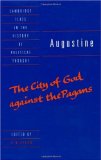
R.W.Dyson's translation of "The City of God"

--------

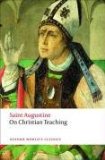
R.P.H. Green's translation of "On Christian Teaching"

--------

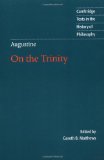
Gareth Matthews' translation of "On The Trinity" (books 8 - 15)


Chapter 3 [III.]—Nature Was Created Sound and Whole; It Was Afterwards Corrupted by Sin. Man’s nature, indeed, was created at first faultless and without any sin; but that nature of man in which every one is born from Adam, now wants the Physician, because it is not sound. All good qualities, no doubt, which it still possesses in its make, life, senses, intellect, it has of the Most High God, its Creator and Maker. But the flaw, which darkens and weakens all those natural goods, so that it has need of illumination and healing, it has not contracted from its blameless Creator—but from that original sin, which it committed by free will. Accordingly, criminal nature has its part in most righteous punishment. For, if we are now newly created in Christ, we were, for all that, children of wrath, even as others, “but God, who is rich in mercy, for His great love wherewith He loved us, even when we were dead in sins, hath quickened us together with Christ, by whose grace we were saved.”


Chapter 4 [IV.]—Free Grace. This grace, however, of Christ, without which neither infants nor adults can be saved, is not rendered for any merits, but is given gratis, on account of which it is also called grace. “Being justified,” says the apostle, “freely through His blood.” Whence they, who are not liberated through grace, either because they are not yet able to hear, or because they are unwilling to obey; or again because they did not receive, at the time when they were unable on account of youth to hear, that bath of regeneration, which they might have received and through which they might have been saved, are indeed justly condemned; because they are not without sin, either that which they have derived from their birth, or that which they have added from their own misconduct. “For all have sinned”—whether in Adam or in themselves—“and come short of the glory of God.”


Chapter 5 [V.]—It Was a Matter of Justice that All Should Be Condemned. The entire mass, therefore, incurs penalty and if the deserved punishment of condemnation were rendered to all, it would without doubt be righteously rendered. They, therefore, who are delivered therefrom by grace are called, not vessels of their own merits, but “vessels of mercy.” But of whose mercy, if not His who sent Christ Jesus into the world to save sinners, whom He foreknew, and foreordained, and called, and justified, and glorified? Now, who could be so madly insane as to fail to give ineffable thanks to the Mercy which liberates whom it would? The man who correctly appreciated the whole subject could not possibly blame the justice of God in wholly condemning all men whatsoever.


Chapter 6 [VI.]—The Pelagians Have Very Strong and Active Minds. If we are simply wise according to the Scriptures, we are not compelled to dispute against the grace of Christ, and to make statements attempting to show that human nature both requires no Physician,—in infants, because it is whole and sound; and in adults, because it is able to suffice for itself in attaining righteousness, if it will. Men no doubt seem to urge acute opinions on these points, but it is only word-wisdom, by which the cross of Christ is made of none effect. This, however, “is not the wisdom which descendeth from above.” The words which follow in the apostle’s statement I am unwilling to quote; for we would rather not be thought to do an injustice to our friends, whose very strong and active minds we should be sorry to see running in a perverse, instead of an upright, course.


Pansophix Online Medium

-----


Mac Users please note that the site may not work with Safari versions lower than version 4. (It has been tested with version 4.0.3.) It will work with Firefox, which can be downloaded from here.

Please note that for all features of the site to work correctly javascript must be enabled and the operation of "pop-up" windows must not be blocked. Click here for more information.


original Latin text
De Natura et Gratia
On nature and grace
Augustine's doctrine of grace
Pelagius and Pelagianism
Migne Latin
Patrologiae Latinae Cursus Completus
Patrologia Latina


Back to Entry Page